
Impulse & Momentum: Inelastic Collisions (Con't)
OPENING QUESTION:
- We'll walk through THIS together (Ignore anything to do with kinetic energy -- we'll do that in our next unit)
CALENDAR:
- Lab Reports are Due looking Good and Standing Tall, LAST FRIDAY
- Impulse and Momentum Test is Monday, February 22nd
FORMULAE OBJECTUS:
m1iv1i + m2iv2i = m1fv1f + m2fv2f (Law of Conservation of Momentum)
p=mv
J = impulse (∆p or F∆T or m∆v or pf - pi)
WORDS O' THE DAY:
- momentum (p=mv)
- impulse (∆p or F∆T)
- kinetic energy (energy of motion)
- Energy (Joules) (J)
- Law of Conservation of Momentum (Momentum of the objects BEFORE a collision must equal the momentum of the objects AFTER a collision)
- Perfectly Elastic collision (Kinetic Energy is conserved AND momentum is conserved)
- Inelastic collision (Energy is lost to heat, sound and other types of energy so KE is NOT conserved although momentum IS conserved)
WORK O' THE DAY:
Practice Problems & Solutions:
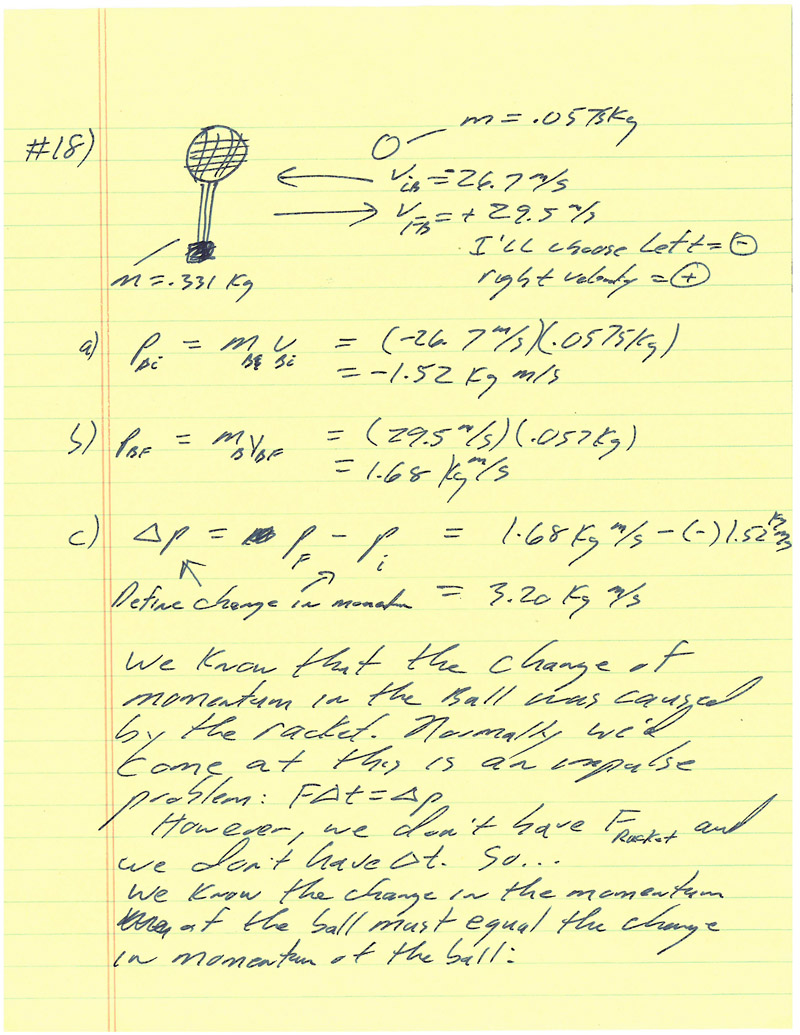
Problem 25 Setup and First Page
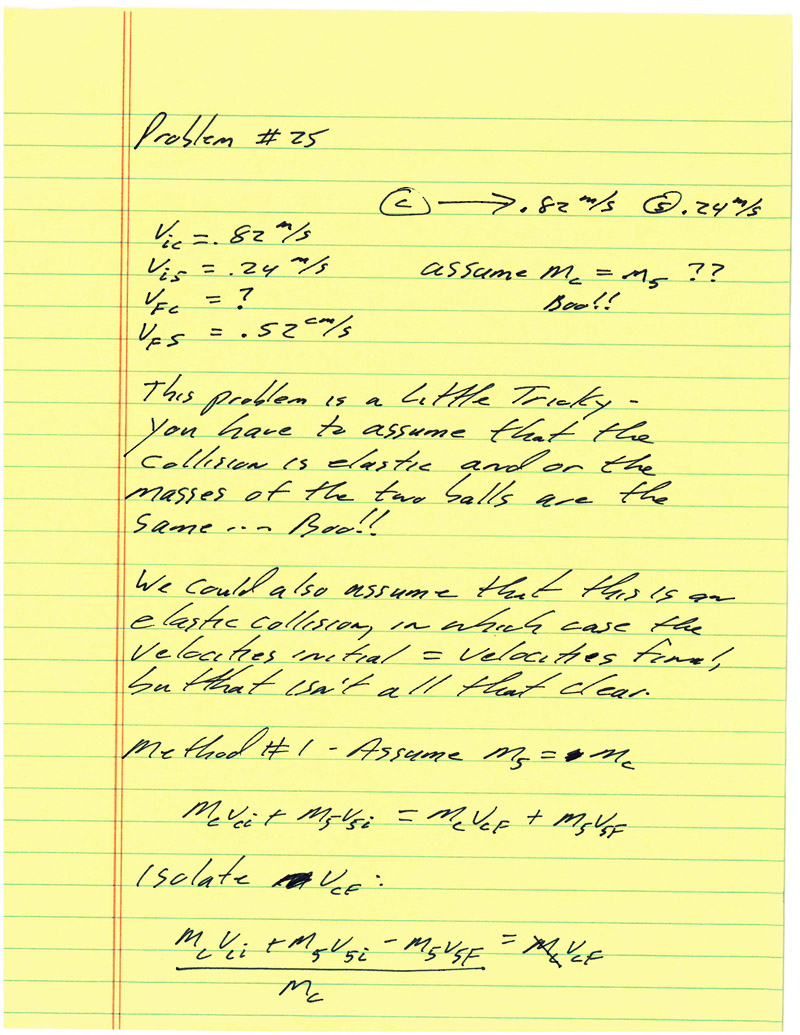
Problem 28 Setup and First Page
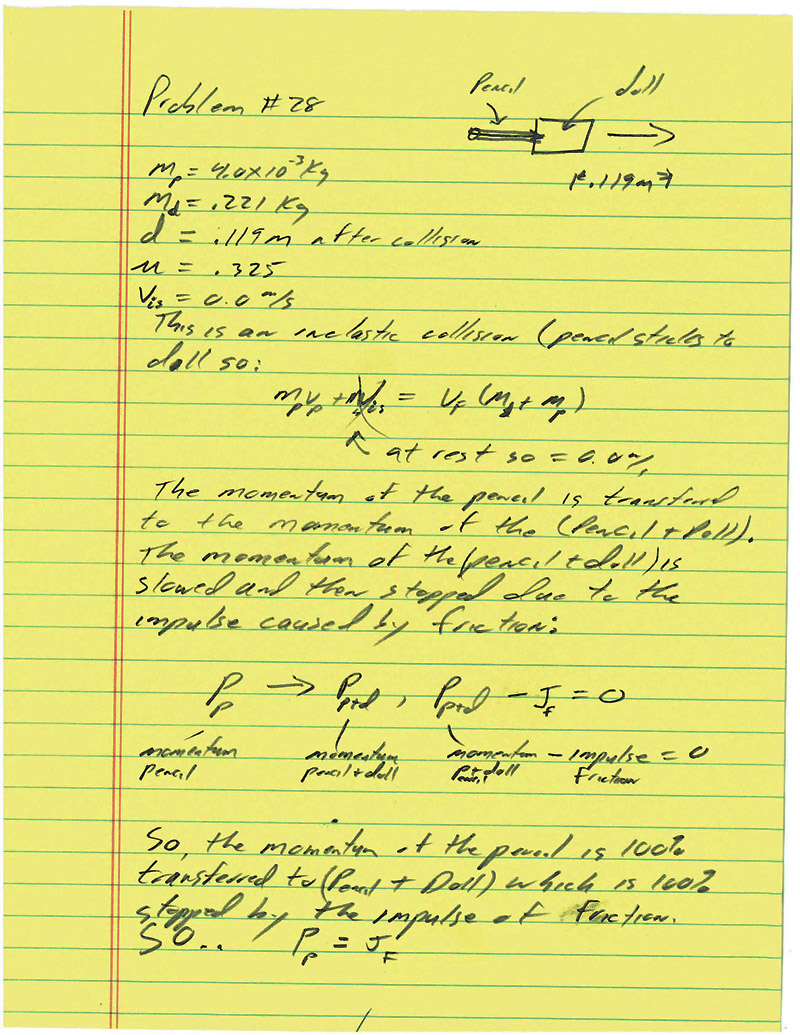
Problem 29 Setup and First Page

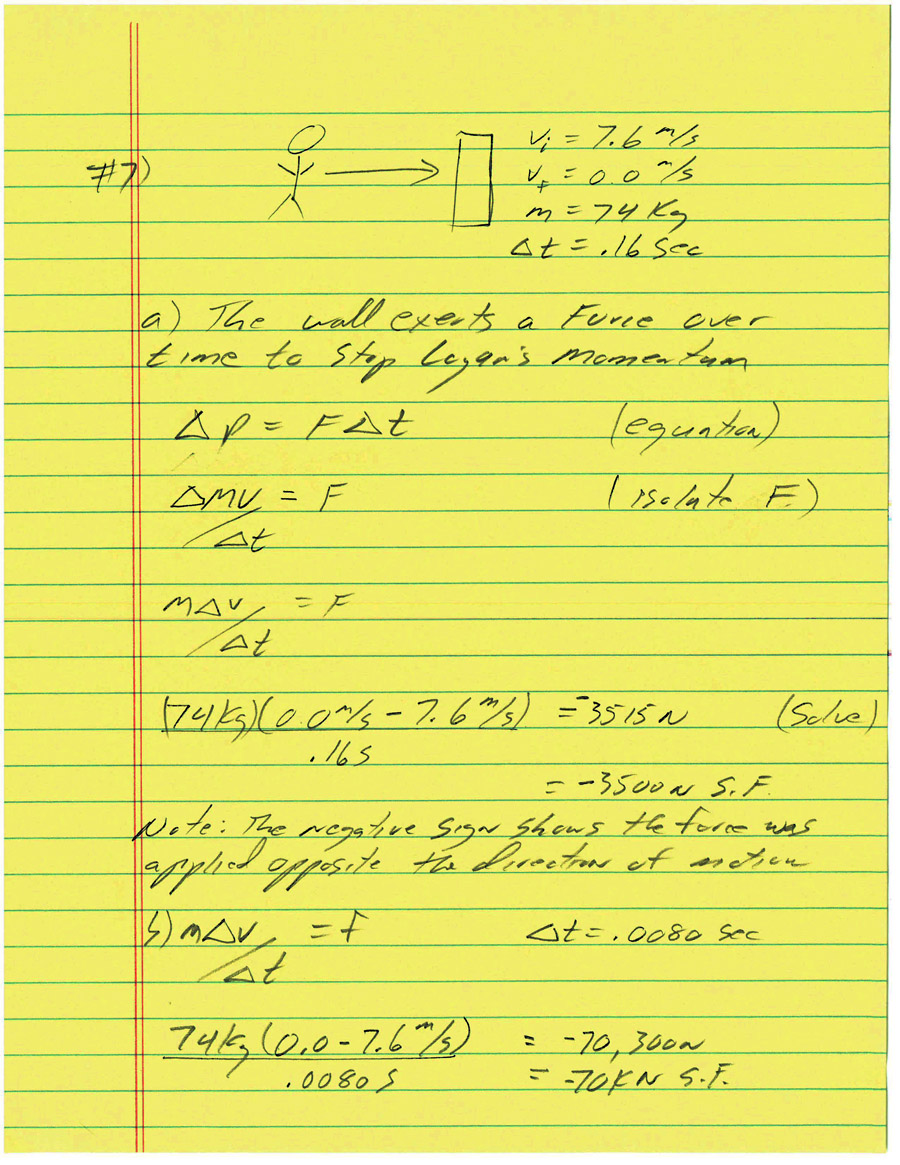
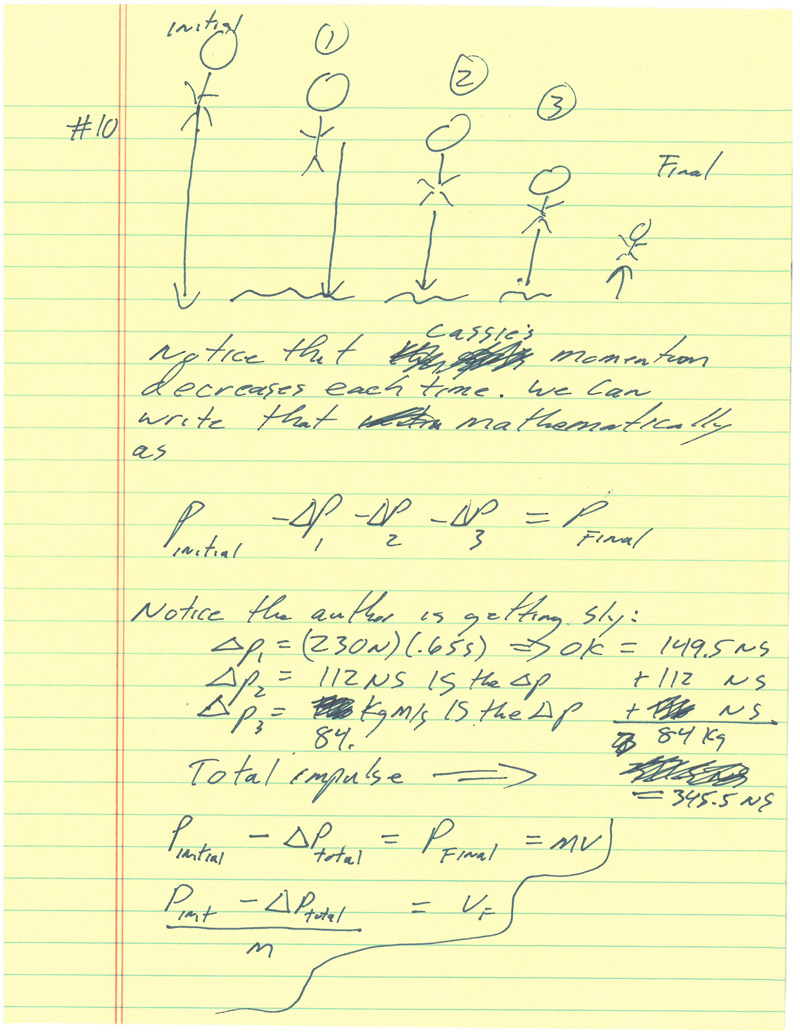
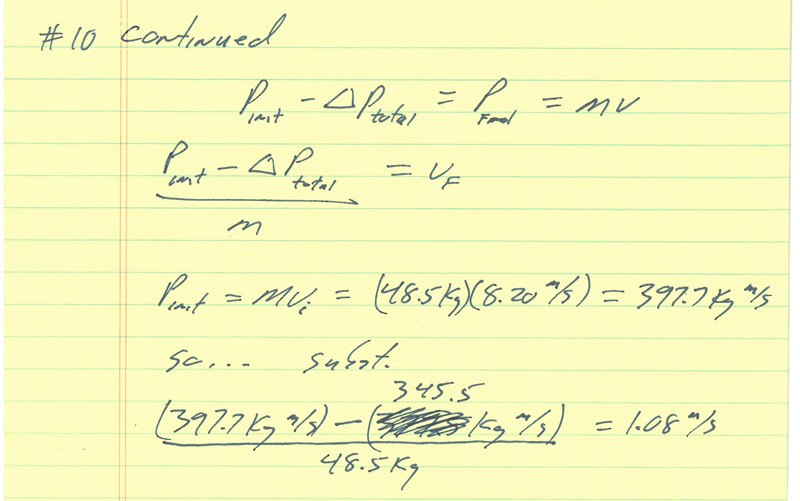
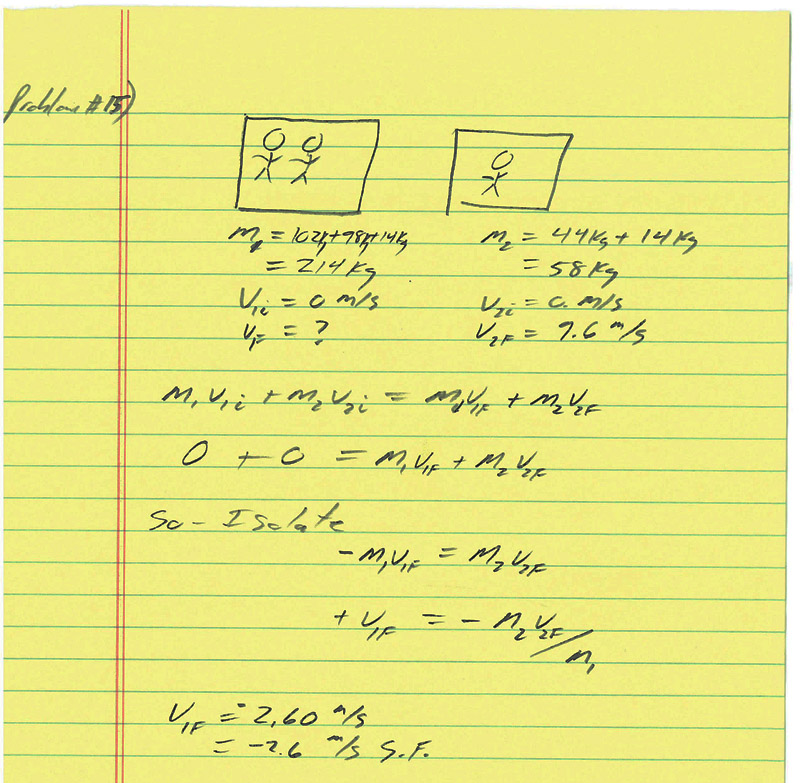

═══════════════════════════
Let's recall:
In an elastic collision, kinetic energy is conserved and momentum is conserved (for example: billiard balls bouncing off each other).
In a perfectly inelastic collision, significant amounts of energy are lost to heat, sound and others so kinetic energy is not conserved and moment is conserved (example: cars stuck together in a crash).
Notice that in each instance, moment IS conserved (hence the LAW of Conservation of Momentum).
1) A .456 kg ball moving to the east with a speed of 11.34 m/s collides head-on with a .754 kg ball moving to the west at a speed of 7.53 m/s. The velocity of the first ball is 8.50 m/s AFTER the collision.
What is the velocity of the second ball after the elastic collision if both balls bounce back in directly opposite directions?
My solution is here (did you do a sketch?)
.jpg)
═══════════════════════════
2a) Imagine a 1350 kg sports car going 30. m/s east crashing head-on into a fully loaded semi (62,000 kg) hauling iron rails to a construction site with a velocity of 22.35 m/s west. The sports car ends up *sticking* to the semi rig and much energy is lost in the collision.
Why is this an example of an inelastic collusion?
Determine the velocity of the car/truck together after the collision
═══════════════════════════
Did you come up with something like this:
initial conditions:
vic = 30. m/s
Note: Negative velocity is KEY here... why?
vit = -22.35 m/s
Note: The final velocity of the truck and the final velocity of the car will be the same... why?
vft= vfc = ?
Note: The mass of the car and truck individually don't change, however they will be stuck together so we'll combine those in a moment
mic = mfc = 1350 kg
mit = mft = 62,000 kg
initial equation:
m1iv1i + m2iv2i = m1fv1f + m2fv2f
rewrite to show actual objects (I'd start this way)
mcivci + mtivti = mcfvcf + mtfvtf
now show the masses stuck together *after* the collision with the same velocity!:
mcivci + mtivti = (mcf + mtf)vf
Now please calculate the mass of the car-truck AFTER the collision. Be SURE to isolate first, and then substitute and then solve.
ANSWER:
mcivci + mtivti = (mcf + mtf)vf
isolate:
(mcivci + mtivti ) / (mcf + mtf) = vf
substitute:
[(1350 kg)(30. m/s) + (62,000 kg)(-22.35 m/s)] / (1350kg + 62,000kg) = vf
DON'T FORGET TO ASSIGN ONE VELOCITY POSITIVE AND ONE VELOCITY NEGATIVE IF THEY ARE MOVING IN OPPOSITE DIRECTIONS!!!!
solve:
= -21 m/s
2b) How much force did the sports car experience if its velocity went to zero in .15 seconds
initial conditions:
vic = 30. m/s
vfc = 0.00 m/s
∆t = .15 seconds
equation:
Why is this just a wee bit nastier now?
F∆t = ∆p
F = ∆p/∆t
What goes next?